ORCID: 0000-0002-8432-842X; Scopus ID: 25825179800; WoS ID: M-6112-2019; Google Scholar: JA Lassa; ResearchGate: Jonatan Lassa RG.
Modesty in the roles of a gardener (a must!); a father and husband; a scholar; an activist (when necessary). I used to live/study and/or fulltime work in the following countries in the last 20 years: Indonesia, England, Germany, USA, Singapore, Australia, New Zealand.
About Me
Only a few rare individual scientists/academics/scholars who can be successful without a team. And obviously, I am not one of them. So, I do not fully agree in academic ranking because good disaster sciences are always a result of collective work of committed individuals from peers to research students. However, one might have argued that any alternative recognition might or might not do justice to those who focus on quality teachings and remain unseen by the world.
Regardless, it was a good feeling that your work is being recognized – as I was awarded: “Top Research in the Field of Emergency Management” by the Australian Research Magazine 2023“, 2024 and 2025. Many disaster scholars deserved to be the one on the List but somehow, they did not categorise themselves to be part of emergency management field under business and management category. So, in a way I was albeit ‘lucky’.
Also, a mixed but still good feeling to be listed as part of top 2% scientist in 2024 and the “Science and Health Editor’s Choice Award 2022” for contributions to science-based journalism focusing on disasters and health in The Conversation (ID) in 2022.
I started my academic career very late as I spent the first 12 years after undergradute in ‘real-world’ professional settings (with NGOs/INGOs, United Nations organizations, the private sector, think tanks and consulting industries). Since 2014, I have the privilege to have been working as a scientist at NTS RSIS-NTU Singapore (2014-2015), and faculty member at CDU Darwin Australia (2016-2024) and later as a senior scientist at Institute of Geological and Nuclear Sciences (GNS Science), New Zealand (since 2024). I still maintain my association with CDU as I still 5 supervise PhD students at CDU as an adjunct senior fellow.
I identify myself as an interdisciplinary social scientist with an engineering background! My research focuses on climate change adaptation, disaster risk reduction, humanitarian studies, emergency planning, crisis management, food security, sustainability science, risk governance, urban-rural resilience and broader societal safety studies. Recently, I have been trying to use Science, Technology and Society (STS) framework to inform my research on disaster and climate change risks.
I have been teaching and supervising students on the interdisciplinary dimension of humanitarian emergency and disaster management at Charles Darwin University, Darwin, Australia (2016-2024) where I was responsible for teaching core units offered in the Master of Emergency and Disaster Management, Master of Health Emergency Preparedness and Response and the Bachelor of Humanitarian Aid and Development. I had the privilege to teach Global Environmental Change and Humanitarian Response course for one semester at Auckland University of Technology in 2024 (contracted via GNS Science).
I completed my PhD at the University of Bonn while based at United Nations University in Bonn, Germany. I also completed one winter-semester post-doctoral fellowship at Ash Center, Harvard Kennedy School, Cambridge, MA, in 2011 and later received a Willis Re Postdoctoral Research Fellow position at the Institute of Catastrophic and Risk Management (ICRM), Nanyang Technological University in 2011/2012.
My contributions to global disaster studies include macro and micro-level disaster governance, complex network theory application in disaster management, institutions and institutionalisation framework in disaster reduction. I am promoting a new concept namely the networked ecosystems approach to humanitarian studies and disaster risk reduction, through both academic papers and consultancy work. My doctoral research has been one of the first systematic studies on disaster governance, looking at institutions and governance practices in disaster reduction in countries around the world. I was the first one who coined and defined the term “disaster risk governance” (DRG) as a framework in my PhD thesis. Google hits on DRG grew from zero in 2007 and now reaching 90,000 as of early 2019.
I am a generalist as my interest is in broader interdisciplinarity and approaches to disaster risk and climate change. I recently worked on understanding the structure of political will on disaster risk reduction and climate change adaptation using a quantitative and qualitative approaches. I have been working on risk objects, disaster policy-making, disasters and utopia, systematic analysis of disaster code/laws (Indonesia and Australia), global mapping on political will for disaster reduction, governing climate and disaster loss, social network analysis and network theory application in climate adaptation and disaster management, multi-hazard + conflict early warning system, humanitarian reform, humanitarian technology, institutional vulnerability assessment, local disaster management policy reform, global and regional humanitarian ecosystems, NGOs/CSOs network structure, urban climate governance, disaster education, food system under climate change and critical realist approach to disaster policy-making.
For Prospective HDR Students, I Welcome PhD students for the following topics.
- Risk reduction, resilience and mitigation
- Intersectionality of disasters, cities, water crisis and urban development
- Disaster policy and utopia
- Climate change, environmental migration and human trafficking
- Disasters’ impact on migration and human trafficking
- Social exclusion, risk and disaster vulnerabilities
- Understanding long-term recovery trends in Southeast Asia [at >30 years timescale]
- Long-term observation of community-based and/or community-led disaster risk management practices in ASEAN.
- Disaster risk governance and decentralization in Southeast Asia and the Pacific
- Using network theory to understand disaster governance in Asia – the Pacific
- Social network analysis and crisis leadership
- Governing climate change adaptation in urban/rural settings as well as agriculture and livestock sectors
- Understanding seismic mitigation culture in Asia and the Pacific Ring of Fire!
- Global thinkers and theorists on disaster studies
- Object-oriented ontology and critical disaster/risk studies
- Disaster policy making and reform in developing countries
- Governing big-data and complexity methods for disaster risk reduction
- Multi-hazard early warning systems
- Open to other and new topics
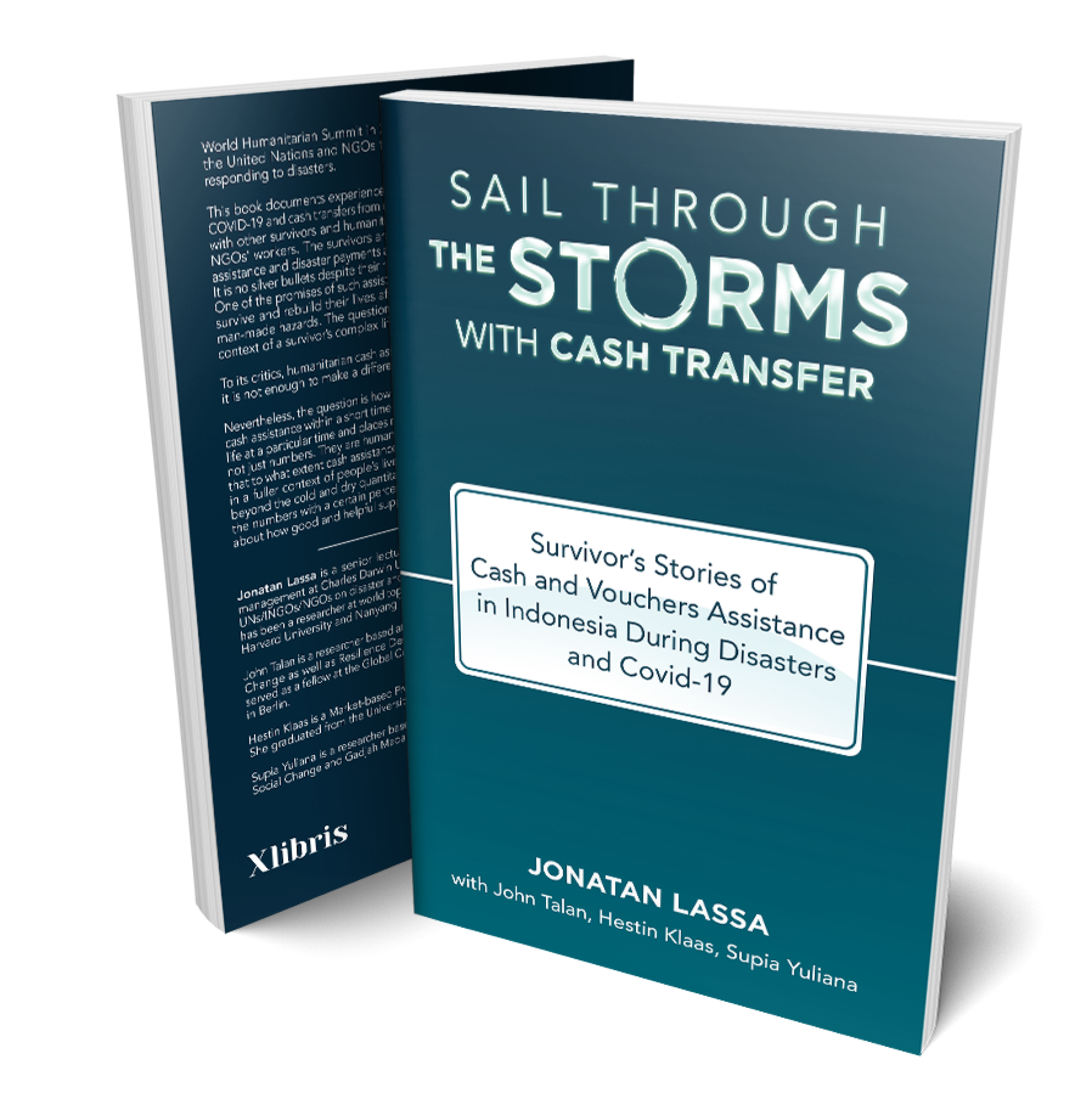
Books
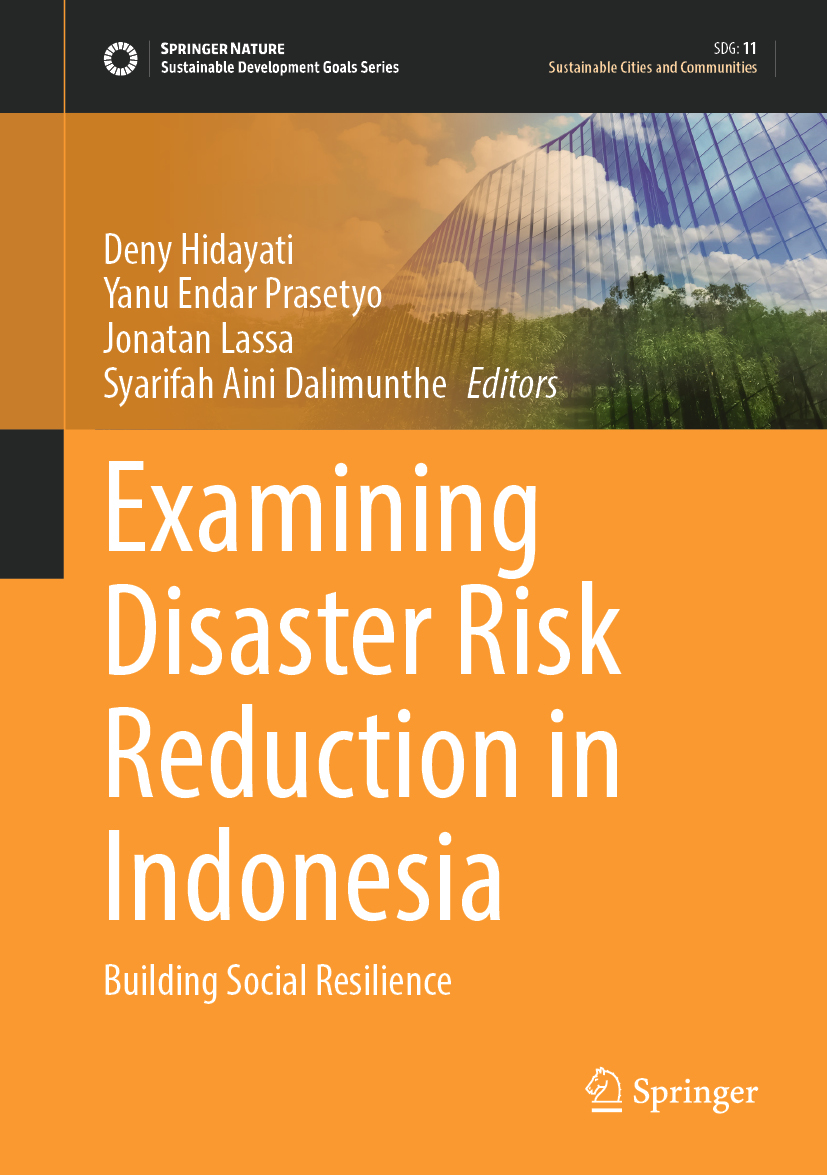
Examining Disaster Risk Reduction in Indonesia
Building Social Resilience
See my current research projects!



 Indosasters Lab - JA Lassa